MY WAY AROUND ~ ONECOTE TO ROACH END ~ BY SALLY MOSLEY

This section of my boundary challenge made my spirits soar as Nellie and I walked to what felt like the top of the world. It brought tears to my eyes from a combination of wonder and cold wind!
The history of Onecote dates back to at least 1199 when the settlement was first recorded. A monastic grange was established here by Croxden Abbey in 1223. Onecote is probably more well-known to motorists however for its former turnpike road running straight through its heart, now the rollercoaster B5053.
We left the village by walking past St Luke’s Church along Douse Lane before turning down towards Onecote Grange to follow a footpath across large fields to Mixon. As we ascended the views behind got more and more distant. There appeared to be a multitude of peaks as far as my eyes could see, some marked with trig points, others with tree topped lows.
Mixon is a mixture of old and new properties and ancillary buildings, the oldest ones constructed to house miners working in the nearby Mixon copper and lead mines. This historic industrial site was worked from the 17th to late 19th centuries.
At the heart of the little hamlet is a part stone-cobbled route down to the mine. However, we headed uphill and then diagonally right across fields and stiles until we reached a small enclosed hilltop reservoir. We then went down a track to pass Old Mixon Hay. Now a working farm, the site was originally established as a 13th century grange associated with Hulton Abbey.
We walked up to meet Blakelow Road which runs along the top of the ridge now known as The Morridge which for a long stretch forms the boundary of the National Park. However, centuries ago before the Enclosure Acts in the 18th century when it was common land, this elevated moorland was called the Great Waste. We turned right and carefully walked roadside to the junction and then past the famous lay-by with topograph. This has stopped many a passer-by or traveller in their tracks, especially on a clear day. It is believed The Morridge was a prehistoric ridge way, so for thousands of years people have gazed from up there in awe and wonderment!
We continued on with extreme care to the former Mermaid Inn. It is said to have been named after nearby Blakemere Pool, the subject of legends and local folklore that include mysterious drownings and a medieval witch thrown into the water only to be transformed into a nymph!
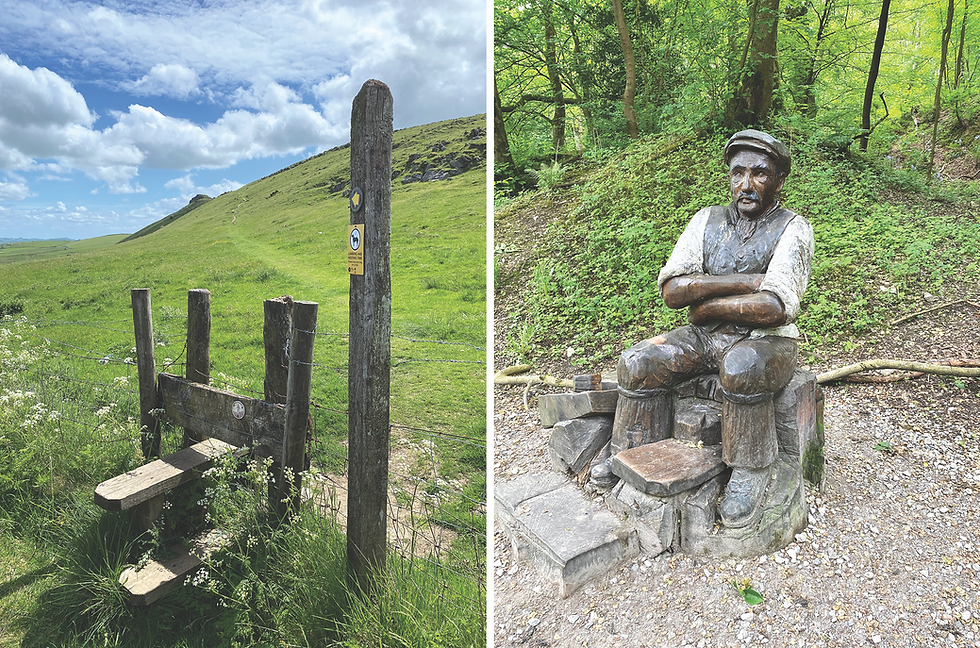
Our route now followed a succession of helpful yellow-coloured posts positioned as waymarkers that guided us down from the remote moorland to sheltered pasture, stepping around clumps of reed grass and squelching in bog. Eventually we met up with a track through Hurdlow Farm that brought us out onto the main A53 at Blackshaw Moor.
After a very careful crossover, we then followed a footpath to Upper Hulme, emerging by old mill and commercial buildings. The Black Brook has provided water power for mills here dating back some 800 years. At one time there was an important silk dying business operating here.
We now left the official boundary route, going off-piste for a few miles as I wanted to walk over the Roaches instead. We therefore headed up past Dains Mill and Well Farm to the bottom end of this incredible gritstone escarpment. To our left was the jagged prominence of Hen Cloud, its name taken from the Old English word clud or clod, which meant a hill, rock, or mass of stone.
Nellie and I followed the steep, rock-strewn path to high ground close to Rockhall Cottage which was built in 1862 as a gamekeepers cottage. Now it is known as Don Whillans Memorial Hut to accommodate climbers who can hire it out if they are members of the British Mountaineering Council. It incorporates a large caved area in the rocks that until the early 1800s was occupied by a woman called Bess Bowyer who lived there all her life until she was nearly a hundred years old.
Nellie and I then walked for two miles or so along the ridge top past Doxey Pool to Roach End. The name ‘The Roaches’ is said to be an anglicised version of the French words ‘Les Roches’, which simply mean the rocks. The weather was perfect and the views were stupendous!
FOOTNOTE BY NELLIE: Mum has discovered that there are two types of Kelpies. One is a working farm dog that can be on the go all day, the other is called a show or bench kelpie and they are believed to have different characteristics. She thinks this explains why I don’t like going near smelly sheep or cattle and prefer to spend lots of time lazing around on the sofa or bed. I’m just a spoilt couch princess who enjoys being the centre of attention. Pass me the nail file Mum, I’ve snagged my claw! Chuckles and kisses, Nellie xx